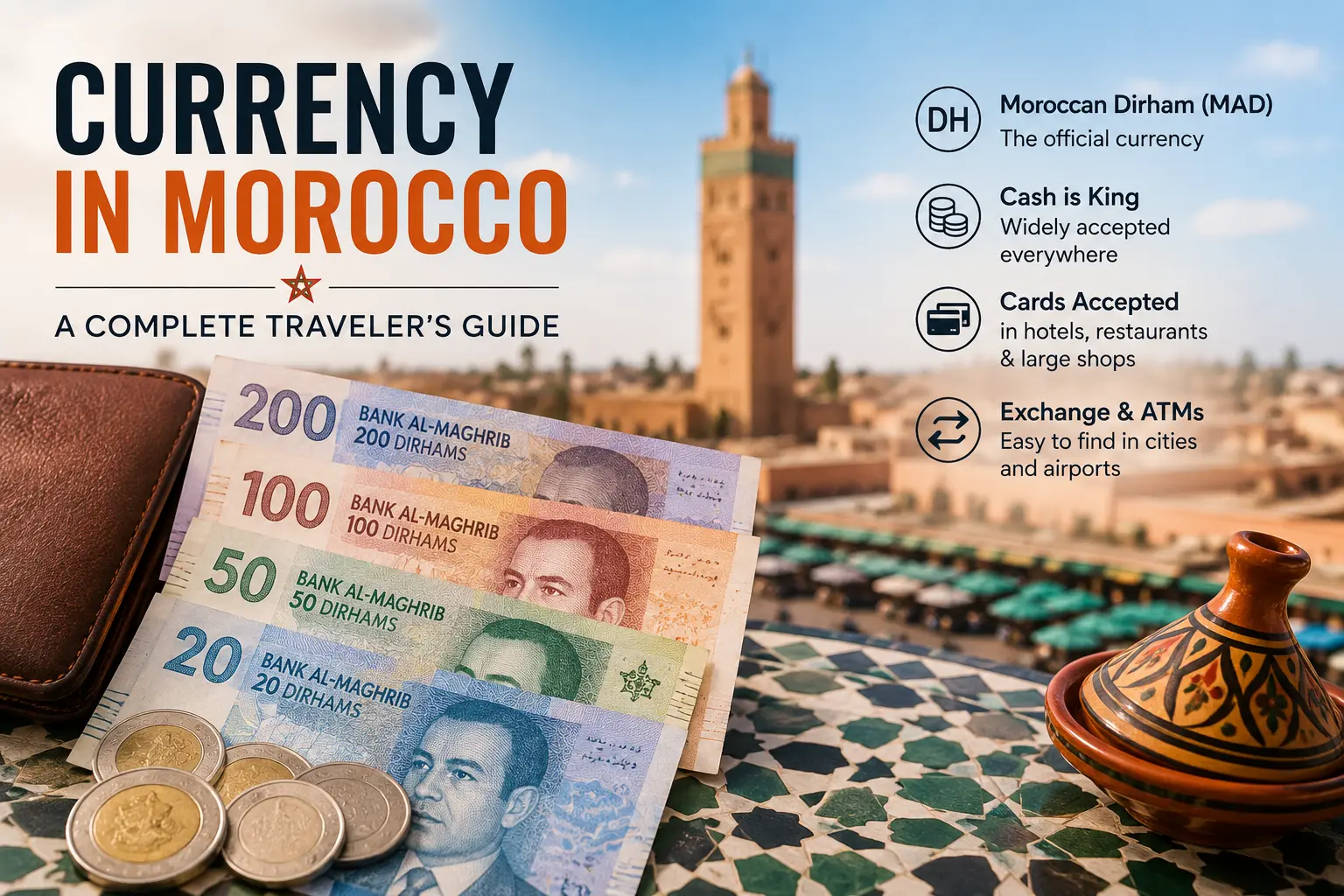
The official currency in Morocco is the Moroccan dirham, identified by the international code MAD and often written locally as DH or Dhs. For most trips, the simplest payment strategy is to use dirhams for everyday purchases, keep some cash in small notes and carry a card for larger expenses or ATM withdrawals.
Morocco is not completely cashless. Cards are commonly accepted by many hotels, established restaurants, supermarkets and larger travel businesses, but cash remains important in medinas, souks, small cafés, local taxis, rural villages and remote desert areas.
You may also see prices discussed in euros, pounds or US dollars in tourist settings. That does not make foreign currency the best choice for normal spending. Paying in Moroccan dirhams usually makes the price clearer and avoids relying on a seller's private exchange rate.
This guide explains how currency in Morocco works, what money to take, where to exchange it, how to use ATMs, when cards are practical and how much cash to carry. Exchange rates, bank fees and payment policies can change, so confirm important details with your card provider and official sources shortly before you travel.
What Currency Does Morocco Use?
Morocco uses the Moroccan dirham as its official currency. Its international currency code is MAD, while prices inside the country may be marked with DH, Dhs or the word dirham.
One dirham is divided into 100 centimes. In normal tourist transactions, the most important point is to confirm that every price you discuss is stated in Moroccan dirhams before you agree to pay.
The dirham is used throughout the country, including Marrakech, Casablanca, Fes, Rabat, Chefchaouen, Essaouira, Agadir, Ouarzazate and Merzouga. Marrakech does not have a separate currency, and neither do the Sahara Desert or Atlas Mountains.
When a hotel, tour or activity displays a price in euros or another foreign currency, ask which exchange rate will be used and whether your final payment will be processed in MAD or in the displayed currency.
- Official currency: Moroccan dirham
- International code: MAD
- Common local abbreviations: DH and Dhs
- One dirham equals 100 centimes
- The same currency is used across Morocco
Moroccan Dirham Notes and Coins
Travelers commonly encounter Moroccan banknotes in denominations of 20, 50, 100 and 200 dirhams, together with coins used for smaller payments. Carrying a mix of values is more useful than relying only on large notes.
Small change matters in daily travel. It is useful for cafés, taxis, market purchases, luggage assistance, public toilets and other low-cost transactions where a seller may not have change for a 200 MAD note.
After withdrawing money or exchanging currency, use a supermarket, restaurant or established shop to break a larger note during a normal purchase. Do not wait until a short taxi ride or small market transaction to ask for extensive change.
Count your cash before leaving an ATM or exchange counter, then store larger notes separately from the smaller amount you expect to use during the day.
- Keep several small notes for routine purchases
- Avoid depending only on 200 MAD notes
- Check the change you receive before walking away
- Separate daily cash from your main travel funds
Cash or Card in Morocco: Which Is Better?
The best answer is to use both. Cash is the most reliable option for small local payments, while a card can be convenient for accommodation, larger restaurants, organized tours and purchases from established businesses.
Do not build your trip around a card alone. A payment terminal may be unavailable, temporarily offline or limited to certain card networks, and smaller businesses may accept only cash.
At the same time, carrying all of your trip money in cash creates unnecessary risk. A balanced approach is to keep a modest amount of dirhams for the day, store a backup card separately and withdraw or exchange additional money when needed.
Before paying, ask whether cards are accepted and whether any fee applies. A card logo at reception does not always mean that every service, restaurant or activity connected to the property can be paid for in the same way.
- Use cash for small and local transactions
- Use cards for suitable larger payments
- Keep a second payment method as a backup
- Confirm card acceptance before receiving a service
- Never rely on one card or one source of cash
Where Do You Need Cash in Morocco?
Cash is especially useful in traditional medinas, souks, small cafés, neighborhood bakeries, local markets, rural villages and roadside stops. These places may not accept cards or may set a practical minimum for card payments.
Petit taxis and many local transport services should also be treated as cash transactions unless the operator clearly confirms another method. Carry small notes and establish how the fare will be calculated before the journey begins.
Day trips and multi-day tours may include stops in mountain, valley or desert areas where there is no nearby ATM. Even when the main tour has been paid online, you may still need cash for lunch, drinks, optional activities, small purchases or tips.
Cash is also useful when a card terminal fails or your bank blocks an unfamiliar transaction. It should be a normal part of your payment plan rather than an emergency afterthought.
- Souks and small market stalls
- Small cafés, bakeries and local restaurants
- Petit taxis and some local transport
- Rural villages and roadside stops
- Small purchases during desert and mountain tours
- Tips and other low-value payments
Can You Use Credit and Debit Cards in Morocco?
Yes, international credit and debit cards can be used at many hotels, larger riads, established restaurants, supermarkets, modern shops and travel companies. Acceptance is less predictable at small independent businesses.
Ask the business before you order, check in or begin an activity if paying by card is essential. This is particularly important at smaller riads, restaurants inside medinas and businesses outside major cities.
Carry the physical card and know its PIN even when you normally use contactless payment at home. Your bank may also apply a foreign transaction fee or use its own exchange rate, so review the card's travel terms before departure.
Keep a backup card in a separate place. If one card is declined, repeatedly trying the same transaction can trigger additional security controls, while a second card or cash can resolve the situation quickly.
- Check foreign transaction and cash-withdrawal fees
- Know your card PIN
- Carry the physical card, not only a phone wallet
- Keep a backup card separately
- Confirm acceptance before committing to a purchase
Can You Use Euros in Morocco?
Euros may be accepted by some hotels, tour operators, desert camps and tourist-oriented businesses, but they are not the most practical currency for everyday payments. Moroccan dirhams remain the clearest choice for normal spending.
When a business accepts euros, it may choose its own conversion rate and return change in dirhams. That rate can be less favorable than exchanging money through a bank, licensed exchange office or ATM.
The same principle applies to British pounds and US dollars. They can be useful as backup funds or for an agreed foreign-currency payment, but you should not expect taxis, cafés, market stalls or small shops to accept them.
Foreign coins are particularly inconvenient because they may be difficult to exchange. If you bring backup currency, use clean banknotes and convert only what you need.
- Use dirhams for routine spending
- Confirm the exchange rate before paying in euros
- Expect change to be returned in dirhams
- Do not depend on foreign currency in small businesses
- Avoid using foreign coins
What Is the Best Currency to Take to Morocco?
There is no single foreign currency that every traveler should take. The best option depends on your home country, bank fees and access to cards that work internationally.
A practical setup is to arrive with at least one functioning bank card and a modest amount of widely exchangeable backup cash. You can then obtain Moroccan dirhams after arrival instead of carrying your entire holiday budget from home.
Travelers from the eurozone may find euros convenient as backup cash, while visitors from the United Kingdom or United States may prefer pounds or dollars. The important comparison is the total cost after exchange margins, card fees and ATM charges, not simply the advertised rate.
If you buy dirhams before departure, compare the rate and any commission with the cost of obtaining money in Morocco. Availability and value can differ between providers.
- A primary international card
- A separate backup card
- A modest amount of exchangeable backup cash
- Enough dirhams for your first immediate expenses when practical
- A plan for obtaining more cash during the trip
Where to Exchange Money in Morocco
Travelers can usually exchange money at airport exchange desks, licensed bureaux de change, banks and some hotels. Rates and commissions can differ, so compare the final amount you will receive rather than looking only at a headline rate.
Airport exchange is useful when you need immediate cash for transport or small arrival expenses. You do not have to exchange your entire budget at the first counter if the rate is not competitive.
In major cities, exchange offices are commonly found in central areas and near tourist districts. Use an established counter, confirm the rate before handing over cash and count the dirhams before leaving.
Ask whether commission is included and keep the receipt. A receipt provides a record of the transaction and may be useful if you later need to explain or reconvert remaining funds.
Avoid informal street exchanges. A slightly better promised rate is not worth the risk of incorrect amounts, counterfeit notes or a dispute with no formal record.
- Compare the final amount after fees
- Exchange only what you expect to use
- Count the money at the counter
- Keep the transaction receipt
- Use licensed or established providers
- Avoid informal currency exchanges
Using ATMs in Morocco
ATMs are widely available in major Moroccan cities and tourist centers, making cash withdrawal a practical option for many visitors. Availability becomes less reliable in small villages, mountain areas and remote desert regions.
Whenever possible, use an ATM attached to or located inside a bank branch during opening hours. If the machine keeps your card or a transaction fails, having staff nearby can make the problem easier to address.
Your total withdrawal cost may include a local ATM fee, a fee from your own bank and an exchange-rate margin. Check your bank's international cash-withdrawal policy before traveling and review the amount shown on the screen before confirming.
Make fewer carefully planned withdrawals if your bank charges a fixed fee, but do not withdraw more cash than you can store safely. The right balance depends on the fees, your itinerary and access to ATMs along the route.
After withdrawing, take the card, cash and receipt before leaving the machine. Put the money away discreetly and avoid counting a large amount in a busy public area.
- Prefer ATMs connected to established bank branches
- Check both local and home-bank fees
- Review the transaction currency before accepting
- Withdraw before traveling to remote regions
- Store the cash securely and discreetly
Pay in Moroccan Dirhams, Not Your Home Currency
An ATM or card terminal may offer to convert the transaction into your home currency. This service is often called dynamic currency conversion.
The converted amount can feel convenient because it is shown in familiar money, but the conversion may include an additional markup. In many cases, selecting Moroccan dirhams allows your own card network or bank to perform the conversion under its normal terms.
Read the screen carefully. Choose MAD or Moroccan dirhams when you want the transaction processed in local currency, and do not accept a conversion simply because the button is highlighted or described as guaranteed.
Your own bank can still charge fees, so paying in MAD does not make every transaction free. It simply avoids accepting an optional merchant or ATM conversion without comparing the cost.
- Look for MAD or Moroccan dirhams on the screen
- Review any displayed conversion rate
- Do not confuse convenience with lower cost
- Check your card provider's own foreign-use fees
How Much Cash Should You Take to Morocco?
You do not need to carry your entire trip budget in cash. A better approach is to keep enough dirhams for one or two days of small expenses, then replenish your supply according to the next stage of your itinerary.
The right amount depends on what has already been paid. A traveler with prepaid accommodation, private transport and tours needs less daily cash than someone paying locally for hotels, meals and activities.
Before leaving a major city for the Atlas Mountains, a long road trip or the Sahara, estimate the cash-only expenses you may face until the next reliable ATM. Include meals, drinks, optional stops, small purchases and gratuities.
Carry the amount in more than one place rather than keeping every note in the same wallet. Retain a separate emergency reserve and avoid displaying your full cash supply during routine payments.
- Carry a modest daily spending amount
- Add extra cash before remote travel stages
- Consider which services are already prepaid
- Keep small notes for low-value expenses
- Store backup cash separately
Currency in Marrakech and Other Moroccan Cities
The currency in Marrakech is the Moroccan dirham, exactly as it is everywhere else in Morocco. The city has many ATMs, exchange offices and card-accepting businesses, particularly in central districts and modern commercial areas.
Inside the medina and souks, cash becomes more important. Some restaurants and larger shops accept cards, but small stalls, taxis and neighborhood businesses may not.
Casablanca, Rabat, Fes, Agadir, Tangier and Essaouira follow the same general pattern: cards are easier to use at established businesses, while dirham cash remains useful for local and low-value transactions.
Do not assume that access in a major city will continue throughout your route. Withdraw or exchange enough money before leaving for remote mountain villages, desert camps or long stretches between towns.
Paying in the Sahara, Atlas Mountains and Rural Morocco
Cash is particularly important when your itinerary moves beyond major cities. Small villages, roadside cafés, local cooperatives and desert camps may have limited or unreliable card facilities.
Obtain enough dirhams before starting a multi-day desert route or mountain journey. Marrakech, Ouarzazate, Errachidia and other larger stops may offer access to banking services, but availability along the road should not be assumed.
Ask your tour operator which meals, entrances, activities and local payments are already included. This makes it easier to estimate the cash you need without carrying an excessive amount.
Even when a camp or accommodation advertises card payment, connectivity can affect the terminal. Keep a cash reserve for essential expenses and settle unclear payment arrangements before entering a remote area.
- Withdraw before leaving a major town
- Confirm what your tour price includes
- Carry small notes for roadside stops
- Keep cash available when connectivity is uncertain
- Do not expect an ATM at every desert or mountain stop
How to Carry Money Safely in Morocco
Use the same practical precautions you would use in any busy travel destination. Keep only the money you expect to spend that day in your main wallet and store the rest separately.
Do not carry all cards, cash and identification together. A second card and emergency reserve are only useful when they are stored somewhere different from the primary wallet.
At an ATM, shield the keypad, avoid assistance from strangers and cancel the transaction if anything appears unusual. Use a bank-based machine in a well-lit area whenever possible.
Check card activity through your banking app when available and report an unrecognized payment promptly. Save your bank's international contact method somewhere other than the card itself.
- Split cash between secure locations
- Keep a backup card separate
- Carry only a daily amount in your wallet
- Use bank-based ATMs in suitable locations
- Monitor transactions during the trip
- Store emergency contact details securely
Common Money Mistakes to Avoid in Morocco
Most payment problems come from relying on one method, failing to confirm the currency or waiting until a remote travel day to look for cash. A simple plan prevents most of these situations.
Another common mistake is focusing only on the exchange rate while ignoring commission, ATM fees and card charges. Compare the complete transaction cost instead of one number.
Finally, do not accept a price that is unclear. Ask for the total in Moroccan dirhams, confirm what is included and keep payment separate from optional tipping.
- Relying only on a card
- Carrying the entire budget in one wallet
- Using large notes for very small purchases
- Accepting home-currency conversion without checking the rate
- Exchanging money informally on the street
- Waiting until a remote route to find an ATM
- Failing to confirm whether a quoted price is in MAD
A Simple Payment Plan for Your Morocco Trip
Before departure, check that your cards work internationally, review the fees and save a contact method for your bank. Carry a second card and a modest amount of backup cash.
After arrival, obtain enough Moroccan dirhams for transport and everyday expenses. Keep small notes accessible and place larger amounts in a separate secure location.
During the trip, use cash where it is expected and cards where they are clearly accepted. Choose MAD when a terminal or ATM asks which currency should be used for the transaction.
Before a desert tour, mountain excursion or rural travel stage, confirm what is prepaid and withdraw enough cash for the period until you return to a larger town.
- Check card fees and international access before departure
- Bring a primary card, backup card and modest cash reserve
- Obtain dirhams for normal spending after arrival
- Use local currency at ATMs and card terminals
- Prepare extra cash before remote routes
- Keep receipts and monitor your balance
Final Advice on Currency in Morocco
The Moroccan dirham is the best currency for everyday spending in Morocco. Use cash for small local transactions, keep a card for suitable larger payments and maintain a separate backup method.
You do not need to exchange your full travel budget at once. Obtain money in manageable amounts, compare the complete cost of each exchange or withdrawal and prepare before traveling into remote areas.
Exchange rates, bank fees and currency rules can change. Check current terms with your bank and relevant official sources before departure, then use this guide as a practical framework for managing money during the journey.
FAQ
Frequently Asked Questions
What currency does Morocco use?
+
Morocco uses the Moroccan dirham. Its international code is MAD, and prices may also be marked with DH or Dhs. The same currency is used in Marrakech, Fes, Casablanca, the Atlas Mountains and the Sahara region.
What is the best currency to take to Morocco?
+
Moroccan dirhams are best for spending inside Morocco. A practical travel setup is to bring an international card, a separate backup card and a modest amount of exchangeable cash, then obtain dirhams after arrival according to your needs.
Can you use euros in Morocco?
+
Some tourist businesses accept euros, but you should not rely on them for everyday payments. Paying in Moroccan dirhams makes prices clearer and is more practical for taxis, cafés, souks, small shops and rural areas.
Is Morocco mainly cash or card?
+
Morocco uses both, but cash remains important. Cards are accepted by many hotels, established restaurants and larger businesses, while cash is commonly needed in medinas, markets, taxis, small cafés and remote areas.
Can I use my credit or debit card in Morocco?
+
Yes, many established businesses and ATMs accept international cards. Acceptance is not universal, so confirm before purchasing, know your PIN, check foreign-use fees and carry cash plus a backup card.
Are there ATMs in Marrakech and Morocco?
+
ATMs are commonly available in Marrakech and other major cities and tourist centers. Access is less reliable in small villages, mountain areas and remote desert regions, so withdraw enough cash before leaving a larger town.
How much cash should I take to Morocco?
+
Carry enough dirhams for one or two days of small expenses rather than your entire trip budget. Increase the amount before desert, mountain or rural travel, and base it on which accommodation, transport, meals and activities are already prepaid.
Should I exchange money before going to Morocco?
+
You may exchange a small amount before departure for immediate expenses, but you do not need to buy your entire budget in advance. Compare rates and fees with licensed exchange offices and ATM withdrawals after arrival.
Should I choose MAD or my home currency at an ATM?
+
Choosing MAD normally lets your own card provider handle the conversion. An ATM's home-currency option may include an additional markup, so review the displayed rate and your bank's fees before confirming.